Typing Tips!


Most, if not all, careers involve some computer-based work and require strong typing skills. Accuracy is equally as important as speed. Some schools have stopped teaching typing altogether, assuming students already possess the skills necessary to be successful in the modern workplace. However, without proper training and practice, many individuals resort to hunt-and-peck typing, or looking down at the keyboard to select the right keys one-by-one. 

The preferred typing method is known as touch-type, or typing without looking at the keyboard. This is much more efficient than hunt-and-peck; the average person types at an average of 40 words per minute, but a person who relies on the touch-type method can exceed 75 words per minute, allowing them to complete their work much more quickly and with minimal errors.

Here are some pointers to improve your own typing skills:

1.) Use the correct starting position

When practicing your typing skills, it’s important to use proper hand placement. To start, keep your fingers positioned over the home row keys (left hand over the A, S, D, and F keys, and the right hand over the J, K, L, and ; keys), with your thumbs hovering over the space bar. From here, you can move your fingers slightly to reach neighboring keys. Your hands should always return this starting position.

2.) Don’t look down your hands

Instead of looking down at your hands, focus on your screen. This can be difficult at first, especially if you have not yet mastered the exact placement of the keys. Looking at the screen will help improve your accuracy because you will be able to catch your typos as they occur. You’ll also begin to memorize the placement of the keys, so you’ll be able to type more quickly as you practice.

3.) Maintain good posture

Sitting in an upright position is going to make it easier to type faster. If you are used to slouching in your chair or working from the couch, try moving to a straight-backed chair or working at your desk.

4.) Find a comfortable position for your hands

The wrong hand placement can make it uncomfortable to type for extended periods of time. The space bar of your keyboard should be centered with your body, so that you are not reading your screen or typing from an angle. As you type, rest your elbows on the table and keep your wrists slightly elevated. You should never bend or angle your wrists dramatically.

5.) Practice!

Nothing is mastered overnight, and in order to really improve your typing accuracy and speed, you need to practice every day. There are many websites that offer free typing skills tests and practice, such as Typing AcademyTypingClub and How To Type. Trust that your speed will improve naturally as you become more familiar with the keyboard.

Tips from: https://www.herzing.edu/blog/5-tips-improving-your-typing-speed-accuracy
How to choose the right planner for you


Choosing the right planner or calendar

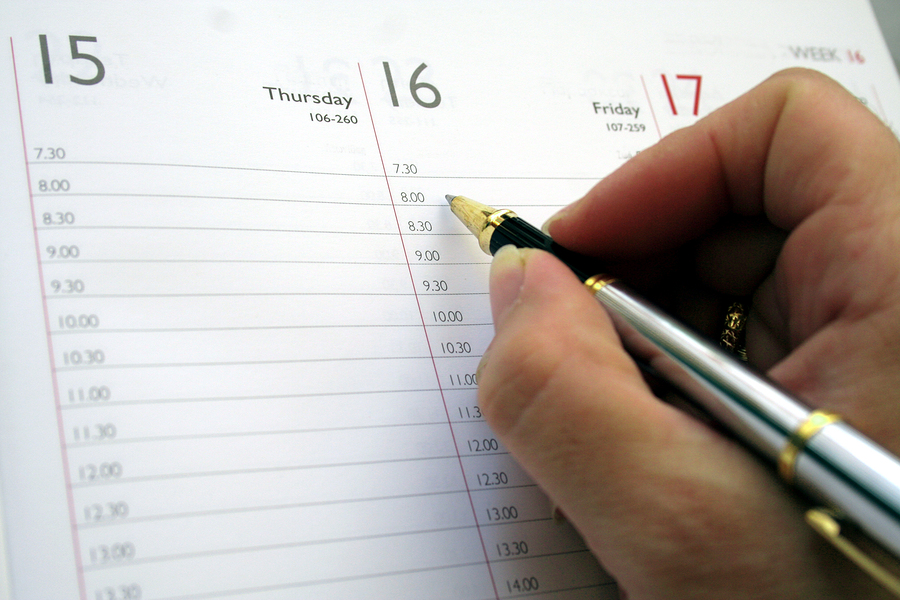
Using a paper planner in this digital age can have some unique advantages. Using a planner that works for you, can help to keep you more organized and productive, which in turn enables you to complete tasks more efficiently. A planner can also help you to declutter your task list and keep on top of appointments and this in turn helps to manage your stress and mental health! Sometimes writing everything down, planning your day, and staying organized can actually help to boost motivation as well. And what feels better than checking everything off of your To Do list by the end of the day!

For such a seemingly small purchase, a planner is a big commitment. It’s your personal assistant for one full year, so it’s important to choose correctly so you don’t miss out on the most important things in your life. But there are so many options. How do you know which planner is right for you? We’ve broken down some important pieces of choosing a planner below!

First – think about how you like to plan – some things to think of:
Do you plan out every minute or do you just need to know when certain appointments fall?
Do you depend on lists?
Do you set goals? Do you want to start setting them?
Do you have a routine? If not, do you want to create one?
What isn’t working with your current planner, if you use one?
How portable would you like it to be?

Think about how you want it bound.
Do you want to be able to move things around? Do you like the idea of a bound, journal like book or does a spiral bound planner appeal to you?

How do you want it to look?
Remember, it’s what you’ll be looking at for a whole year or longer. So consider the style. Think about color, texture, picture or graphic. Do you want to be able to change the cover easily or not?

Some Types of planners:

Daily vs. Weekly

If you want an hour-by-hour view of your day, a daily planner is right for you. It will keep all of your appointments in one easy-to-find place. But if you’d rather take a quick scan to see what’s on for today without breaking it down hour-by-hour, a weekly planner is what you need.

Bullet Planner

Whether you need to get a better handle on your to-do list or want an outlet to help you relax, a bullet journal can help. Think of it as a next-level diary for not only writing but also drawing. Instead of blank, lined pages, or dated pages, a bullet journal contains sections to log daily to-dos, keep a monthly or weekly calendar, jot down notes, track both physiological and mental health, and record both short- and long-term goals.

Some features to think about:

Tabs

Need to flip ahead and see what’s coming up in October? Or do you want to keep your business and personal separate? Look for a planner with tabs. With a glance and a flip, you will quickly find the section you need.

Pockets

For the person with print-outs, receipts and business cards in every jacket, purse or wallet, a planner with pockets is right for you. It will keep all of your important documents in one place.

Note Fields

It’s the all-purpose planner. If you cringe at carrying an armful of notebooks, calendars and planners to the meeting, look for a planner with lots of note space.

Size

Want to journal, stay organized and keep contacts in one place? Go for a large planner. It may seem hefty to lug around, but when you consider all of the items you won’t need anymore — like a date book and note pad — it’s actually a concise way to go. If you want something that can fit into your clutch, forgo the extra features and look for a simple daily or weekly planner.

#LeftHandersDay – August 13!


Barack Obama. Paul McCartney. Oprah Winfrey. Tracy from accounting. These are just a few of the great left-handers that have impacted our lives. And on August 13, we’re paying tribute to them.

Happy #LeftHandersDay

After years of struggling with scissors and can-openers, southpaws are getting the recognition and respect they deserve. It’s Left-Handers Day! And to celebrate, we’re sharing a few things that make lefties so special.

  • 13% of the world’s population is left-handed. And it’s not by random luck. Scientists believe that the trait is genetic, meaning it runs in certain families.
  • Mensa says that 20% of its brainy members are lefties.
  • Lefties are better drivers. According to one study, being left-handed makes you 10% more likely to pass your driving test on the first try.
  • Of the team of five that developed the first-ever Mac computer, 80% were left-handed.
  • If you’re left-handed, you likely earn 15% more than your right-handed peers. Studies show that this may have to do with lefties being well-suited to leadership and entrepreneurial roles.
  • Though roughly one-in-ten people are left-handed, one-quarter of Apollo astronauts were lefties.
  • According to the ancient Zuni people, left-handedness was a sign of wisdom and good luck.